Wydawnictwo
AWSGE
AWSGE

Akademia Nauk Stosowanych
WSGE
im. Alcide De Gasperi
WSGE
im. Alcide De Gasperi
BOOK
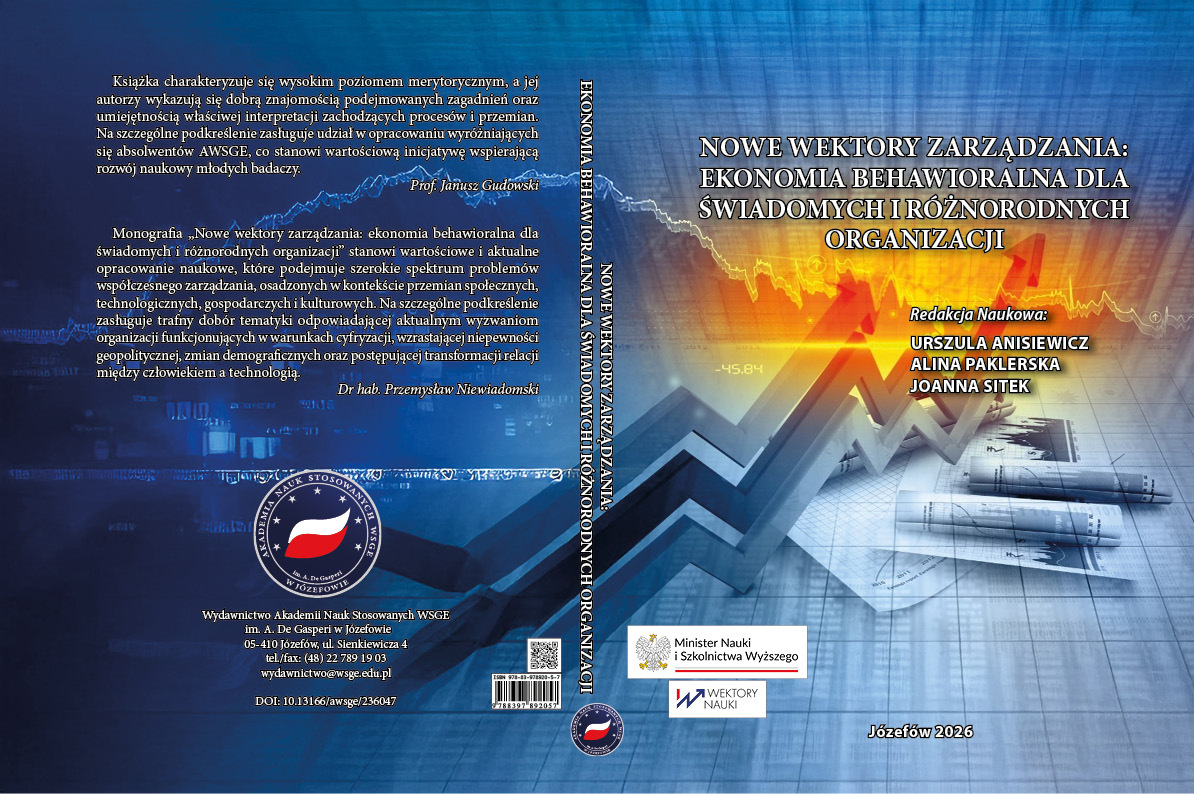
Nowe wektory zarządzania: Ekonomia behawioralna dla świadomych i różnorodnych organizacji
Publication date
2026-10-10
ISBN
978-83-978920-5-7
Place
Józefów
Format
148x210
Binding
Pages count
Publisher
Akademia Nauk Stosowanych WSGE im. A. De Gasperi w Józefowie
CHAPTERS
Risk Management in the Context of Digitalization
Marta Barna, Zoriana Novosad
16-39
Accessibility for People with Disabilities in the Blue Flag Criteria: An Evaluation of the Application in Türkiye
Ayhan Dağdeviren
40-57
Artificial Intelligence and Behavioral Management
Jolanta Kloc
58-107
Legal regulations and organizational culture – determinants of the effectiveness of the compliance system
Monika Nowikowska
108-124
Geopolitics - growing impact on company management decisions
Krystyna Palonka-Pulikowska
125-145
Determinants of exhibitors’ perceived value of B2B trade fair participation in a declining industry: can event organisation quality compensate for exhibitor marketing capabilities?
Małgorzata Róg-Giacosa
146-172
Behavioral Shaping of Attitudes Toward Aging as a Tool for Building Inclusive Organizations
Artur Banaszak
173-201
Woman in Advertising: A Behavioral Economics Perspective. An Analysis of the Perception of Femvertising Based on a Selected Advertisement
Urszula Anisiewicz
202-227
Mobbing as a Contemporary Threat in the Workplace
Weronika Bobisz
228-258
Programy lojalnościowe klientów a satysfakcja pasażerów w branży lotniczej: studium przypadku Ethiopian Airlines
Lishan Weldemichael
259-289
The role of strategic management in enhancing NGO performance: a case study of ethiopian civil society organizations
Hermon Weldemicheal
290-312
Culture and leadership style effectiveness: a comparative study between Ethiopia and Poland
Tihut Getahun
313-345
346-362
363-378
ABSTRACT
Contemporary organizations operate under an unprecedented dynamic of social, economic, and technological change. Globalization, the digitalization of managerial processes, and the development of artificial intelligence, coupled with growing geopolitical and economic uncertainty, mean that effective management is no longer solely the domain of economic, financial, or organizational knowledge. It is becoming increasingly evident that sound managerial decisions rest on an understanding of human beings – their emotions, motivations, cognitive limitations, and needs related to security, dignity, and belonging. It is precisely this perspective – combining theoretical reflection with practical experience – that forms the guiding thread of this monograph, prepared on the basis of the 6th Scientific Conference “New Vectors of Management: Behavioral Economics for Conscious and Diverse Organizations,” held as part of the series “The Digital Society and Concepts of Organizational Management.”
As Daniel Kahneman observed, dispelling the myth of the perfectly rational consumer, in his book Thinking, Fast and Slow: “Our thinking is far more prone to error and far more susceptible to emotion than we tend to assume.” This observation, formulated over a decade ago, has gained renewed relevance today. Behavioral economics, by integrating the achievements of cognitive and social psychology with classical economic theory, provides tools for better understanding decision-making processes, social relations, and the mechanisms underlying the functioning of contemporary organizations. It also teaches that the organizations of the future should be built on a foundation of empathy, diversity, responsibility, and conscious leadership – values that run through all the chapters of this monograph.
The structure of the monograph reflects the multifaceted nature of the issues addressed – ranging from risk and digitalization, through artificial intelligence, legal regulation, geopolitics, and marketing, to diversity, employee well-being, and leadership from a cross-cultural perspective.
The opening chapter, by M. Barna and Z. Novosad, is devoted to risk management in the context of digitalization. The authors present a comparative analysis of two methods used to support decision-making under conditions of uncertainty – correlation and regression analysis, and expert assessment methods – highlighting their methodological foundations, strengths, and limitations in application to higher education. On the basis of a survey study, they identify the need to combine study with work as the most significant educational challenge.
In the second chapter, A. Dağdeviren addresses the accessibility of infrastructure for people with disabilities in the context of the Blue Flag programme criteria, examining its application on beaches in Türkiye. The author points to the need to ensure a continuous, safe route from parking areas to the water, as well as regular monitoring of infrastructure compliance with technical requirements, situating the chapter within a broader reflection on the inclusivity of public space.
The chapter by J. Kloc shifts the discussion to artificial intelligence and behavioral management. The author presents the theoretical foundations of behavioral management and analyzes the opportunities and challenges associated with the use of machine learning algorithms, predictive analytics, and recommendation systems in monitoring and shaping employee behavior. A significant part of the discussion is devoted to the ethical dimension of these solutions – the protection of privacy, algorithmic transparency, and the risk of decision-making bias. The chapter's conclusion, pointing to the need to maintain a balance between organizational effectiveness and respect for individual autonomy, resonates with the central theme of the entire monograph.
M. Nowikowska examines the relationship between legal regulation and organizational culture as determinants of the effectiveness of compliance systems. The author shows that the effectiveness of mechanisms ensuring an organization's compliance with the law and ethical standards does not stem solely from the quality of control procedures, but to a significant extent from the organizational culture within which they operate. It is emphasized that regulatory compliance is, in practice, co-shaped by the attitudes and values shared by an organization's members.
K. Palonka-Pulikowska addresses the issue of geopolitics and its growing impact on corporate management decisions. The author points to the gradual replacement of the globalization paradigm by a geopolitical approach, and to the growing importance of geoeconomics, which employs economic instruments to pursue political objectives. She analyzes the impact of sanctions, trade restrictions, embargoes, and export and import controls on the functioning of enterprises amid the transition from the existing international order toward a more fragmented and multipolar system, shaped to a large extent by the economic rivalry between the United States and China. The chapter raises the fundamental question of the limits within which a contemporary market economy can function in the face of the growing politicization of economic decisions.
M. Róg-Giacosa shifts the discussion to the level of business relationships, analyzing the determinants of exhibitors' perceived value of participation in B2B trade fairs in a declining industry, using the example of the Kids’ Time International Fair in Kielce. Using exploratory factor analysis, correlation analysis, and multiple linear regression, the author demonstrates that exhibitors' marketing capabilities – rather than the quality of event organization – have a stronger effect on the business outcomes achieved, although organizational quality remains important for the overall evaluation of the event and for exhibitors' willingness to recommend it.
A. Banaszak addresses the behavioral shaping of attitudes toward old age as a tool for building inclusive organizations. Using the example of an original workshop programme, “Understanding Old Age,” which employs a geriatric-experience simulator, the author analyzes the mechanisms through which experiential education reduces ageism and stereotypes concerning older people. The chapter emphasizes the role of direct experience of the limitations associated with the aging process in fostering empathy and intergenerational solidarity.
U. Anisiewicz combines a behavioral-economics perspective with an analysis of marketing communication, addressing the representation of women in advertising in the context of femvertising. Drawing on a survey study, the chapter examines the extent to which consumer responses to advertising messages that emphasize female empowerment are rational, and the extent to which they are shaped by cognitive heuristics. The chapter offers an interesting case study of how categories from behavioral economics intersect with marketing practice and the social perception of authenticity in advertising messages.
W. Bobisz addresses the topic of mobbing as a contemporary threat in the workplace, a subject of considerable importance for human resource management. The author points out that a rapidly changing labor market, pressure to meet performance targets, and evolving management styles all contribute to the intensification of pathological behaviors, the consequences of which affect not only employees' physical and mental health but also workplace atmosphere, staff turnover, and companies' financial performance.
L. Weldemichael presents the results of a study on the impact of loyalty programmes on passenger satisfaction in the airline industry. Amid strong competition from Middle Eastern and European carriers, the author examines how individual elements of a loyalty programme influence customer satisfaction.
H. Weldemichael, in turn, addresses the role of strategic management in enhancing the effectiveness of Ethiopian civil society and non-governmental organizations. The author examines these organizations' managerial practices, the relationship between strategic planning and effectiveness, the role of leadership, and the barriers that hinder the implementation of strategic management in the non-governmental sector.
T. Getahun presents a comparative analysis of the influence of national culture on the effectiveness of leadership styles in Ethiopia and Poland. D. Biały, in turn, broadens the scope of the issues discussed by introducing an original research perspective that contributes to the monograph’s exploration of the behavioral and organizational dimensions of contemporary management. The author examines the productivity paradox in organizations, focusing on the relationship between the growing number of information technology tools used in the workplace and the increasing prevalence of digital cognitive fatigue.
The monograph concludes with a chapter by J. Nowicka, devoted to the analysis and comparison of logistics processes implemented at selected historic sites in the Wałbrzych Agglomeration. The chapter examines information flows, deliveries, warehousing, transportation, and stakeholder service. Drawing on statistical methods, the author highlights the importance of historical logistics practices both for the preservation of cultural heritage and for the improvement of contemporary logistics management practices.
Although the chapters included in the monograph vary in terms of subject matter, methodology, and geographical scope, they share a common concern with understanding the mechanisms underlying human behavior in organizations and identifying ways to develop structures that are more aware, responsible, and inclusive. They contribute to the broader field of behavioral economics, understood not merely as a subdiscipline of economics but as an epistemological perspective that integrates insights from psychology, law, marketing, and management.
INFORMATION ABOUT ANTI-PLAGIARISM CHECKING AND PEER REVIEW
Article has been screened for originality




We process personal data collected when visiting the website. The function of obtaining information about users and their behavior is carried out by voluntarily entered information in forms and saving cookies in end devices. Data, including cookies, are used to provide services, improve the user experience and to analyze the traffic in accordance with the Privacy policy. Data are also collected and processed by Google Analytics tool (more).
You can change cookies settings in your browser. Restricted use of cookies in the browser configuration may affect some functionalities of the website.
You can change cookies settings in your browser. Restricted use of cookies in the browser configuration may affect some functionalities of the website.